NEJM
|

Although some patients with type 1 diabetes mellitus have complications, such as diabetic nephropathy, many do not. Thus, a simple, noninvasive method of identifying those at highest � and lowest � risk for the development of complications would be invaluable.
Certain markers, such as microalbuminuria, which indicates the presence of very early renal disease, offer some promise. Yet if microalbuminuria is present, there is already substantial renal injury, which may prove difficult or impossible to reverse. The level of glycosylated hemoglobin is directly related to the risk of microalbuminuria, as well as other diabetic complications. Maintaining glycosylated hemoglobin at a target level is certainly an important goal, but it is often hard to achieve. It is also difficult to control hypertension, which is another established risk factor for the development of diabetic nephropathy. However, by the time a patient with diabetes has frankly high blood pressure, there is already likely to be renal damage. Can earlier detection of changes in blood pressure predict the risk of declining renal function?
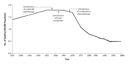
On the basis of other studies of risk factors for cardiovascular and renal diseases, a likely marker would be an alteration in the normal circadian pattern of blood pressure. Blood pressure is lowest in the early morning, rises as the day progresses, then dips down during the night and earliest hours of the morning (see Figure). Both cross-sectional and prospective data suggest that an altered circadian pattern of blood pressure is tied to the presence of various renal diseases and to left ventricular hypertrophy, as well as to markers of early renal disease, such as microalbuminuria. Ambulatory blood-pressure monitoring has already been used to show that abnormalities in the circadian pattern of blood pressure are directly correlated with evidence of renal disease.
|
In this issue of the Journal, Lurbe and colleagues (pages 797�805) go one step further. They present findings suggesting that changes in the circadian pattern of blood pressure in patients with type 1 diabetes may predict the development of albuminuria. Specifically, the authors report that a relative increase in nocturnal blood pressure presages the subsequent development of microalbuminuria. They studied a cohort of 75 adolescents and young adults who had normal rates of albumin excretion and normal blood pressure, measured in the office and by means of ambulatory 24-hour monitoring, at the start of the study. Ambulatory blood pressure was monitored again two years later, at which point all the patients still had normal albumin excretion. Microalbuminuria subsequently developed in 14 of the 75 patients. Those who did not have a nocturnal decrease in blood pressure were far more likely to have microalbuminuria in the subsequent years of follow-up. Such findings are of interest, since 24-hour ambulatory monitoring is a simple, noninvasive method of measuring blood pressure.
Does this mean that round-the-clock monitoring of blood pressure should become a standard procedure? Blood pressure not only follows a circadian rhythm but also varies from minute to minute, depending on levels of stress and physical activity, as well as other determinants of cardiovascular tone. Thus, blood pressure measured at a random moment cannot fully reflect blood-pressure levels around the clock.
Methods of recording round-the-clock blood pressure have been in use for 40 years, and easy-to-use devices have been widely available for at least the past 15 years, linked to computer programs that can process all the data points generated. In the past decade, the instrumentation for measuring round-the-clock blood pressure with ambulatory devices has become increasingly accurate and user-friendly. In April 2002, Medicare began covering the cost of ambulatory blood-pressure monitoring when prescribed to determine the presence or absence of "white-coat hypertension," in which a person's blood pressure is elevated in the doctor's office, yet apparently not elevated elsewhere. Many insurers also cover the cost of ambulatory blood-pressure monitoring for the purposes of assessing blood-pressure control with medication and determining whether the circadian rhythm of blood pressure is normal or disordered. Normal values for ambulatory blood pressure are available for adults and, to a lesser extent, for children and adolescents; in fact, a special terminology has been developed to describe the circadian rhythm.
Does ambulatory blood-pressure monitoring have drawbacks? There are very few, other than the slight inconvenience of wearing the device and the fact that not every monitoring session is technically successful and not all monitors are accurate. As for the cost, if ambulatory monitoring can provide a more accurate assessment of whether blood pressure is elevated or whether a dose of antihypertensive medication is effective, the associated costs will be more than offset by the savings involved, assuming, of course, that the findings can be used to avoid expensive evaluations, overmedication, and the like. Furthermore, if a person's circadian blood-pressure pattern can be used to predict the risk of medical problems, it may be an invaluable clinical marker.
The findings reported by Lurbe et al., if confirmed, could argue for treatment with an angiotensin-converting�enzyme inhibitor or an angiotensin-receptor antagonist in patients with type 1 diabetes mellitus in whom relative nocturnal hypertension develops. Additional studies with long-term follow-up will be needed to learn whether these observations can be generalized to a larger group of patients.
Julie R. Ingelfinger, M.D.