PERSPECTIVE
NEJM
|

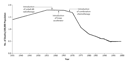
Sepsis, a leading cause of death in the United States, is now viewed physiologically as a proinflammatory and procoagulant response to invading pathogens. There are three recognized stages in the hierarchy of the inflammatory response, with progressively increased risk of end-organ failure and death: sepsis, severe sepsis, and septic shock. Patients with infection plus two or more elements of the systemic inflammatory response syndrome meet the criteria for sepsis; those who also have end-organ failure are considered to have severe sepsis; and those who also have refractory hypotension are considered to be in septic shock (see Figure). Because the crude mortality from all stages of sepsis translates to approximately 210,000 deaths annually, any adjunctive therapy that led to improved outcomes would be welcomed.
|
Clearly, the early use of appropriate antibiotics can reduce mortality from sepsis. Thus, the skill of the clinician can be measured by the effectiveness of empirical therapy that targets both the species and the antibiotic sensitivity of likely pathogens. For patients who are in septic shock, there are some data suggesting that the early use of vasopressors, bolus intravenous fluids, and physiologic doses of hydrocortisone favorably influences mortality. However, the holy grail that has eluded investigators for two decades is a novel therapy targeting the biologic triggers of sepsis.
Recently, it has been recognized that important responses to sepsis occur on endovascular surfaces. Microorganisms stimulate macrophages to elaborate a variety of provocative cytokines, which, in turn, target proteins located on small vessels and thereby alter the normally antiinflammatory and anticoagulant ecology by causing inflammation and clotting. A key vascular protein orchestrating many of the normal regulatory functions is activated protein C. However, in severe sepsis and septic shock, levels of activated protein C are often reduced, with coincident procoagulation, failure of normal fibrinolysis, leaky capillaries, and other correlates of inflammation.
In March 2001, Bernard and colleagues presented data in the Journal from their pivotal study, showing a reduction in 28-day mortality among patients with severe sepsis and septic shock who received recombinant human activated protein C. The death rate was 30.8 percent among controls and 24.7 percent in the group receiving activated protein C (P=0.005). Subsequently, 10 members of an advisory panel of the Food and Drug Administration (FDA) voted for approval of the drug and 10 voted against it, but drotrecogin was licensed in November 2001.
Controversy surrounds both the study and the FDA approval. In the latter half of the study, the sponsor (Eli Lilly) not only modified the eligibility criteria but also used a different cell line for the production of human recombinant activated protein C. In terms of outcomes, the absolute difference in mortality � 6.1 percent � seemed small to some, and there was an increased risk of serious bleeding (an absolute difference of 1.4 percent) associated with activated protein C therapy. Subsequently, the FDA performed a post hoc analysis of the data and found that activated protein C benefited primarily the most seriously ill patients � those with scores of 25 or more on the Acute Physiology and Chronic Health Evaluation (APACHE II). The FDA's analysis became the basis of an unprecedented indication for a drug: a score calculated on the basis of current physiological markers and chronic health status has never before been a criterion for approved treatment. Furthermore, the cost of activated protein C is approximately $7,000 per course � a substantial investment at a time of budget constraints in critical care units.
In this issue of the Journal, three articles and a letter to the editor frame the issues of the debate over the value of activated protein C. In a Sounding Board article (see pages 1030�1034), Siegel, from the Center for Biologics Evaluation and Research, argues that the changes in eligibility criteria created inconsistencies over time only in the lower-risk population (patients with APACHE II scores of 24 or less). Concluding that the amended protocol did not account for the subsequently improved study outcomes, he defends the FDA approval. In another Sounding Board article (see pages 1027�1030), Warren and colleagues (all of whom were consultants to the FDA's Anti-Infective Drugs Advisory Committee) argue that the results of post hoc analyses require confirmation in a new study. They conclude that the existing data fail to support the use of activated protein C as the standard of care. Manns and colleagues (see pages 993�1000), who created mathematical models of the economic value of activated protein C, estimate that the cost of a life-year gained with the use of the drug would be about $28,000. However, in patients with an APACHE II score of less than 25, the cost could exceed $500,000 per life-year gained.
In a letter to the editor (see pages 1035�1036), Ely and colleagues, authors of the original study, provide some updated information: almost 2800 patients have received activated protein C, with a crude mortality of 25 to 26 percent � the same figure observed in the treated group in the pivotal study. Furthermore, of the 13 patients with intracranial hemorrhage (0.5 percent), 9 had meningitis, marked thrombocytopenia (a platelet count of less than 30,000 per cubic millimeter), or both. From these four pieces, those of us who are reviewing the arguments surrounding the current debate on the value of activated protein C will gain insights that may guide us in answering the key clinical question: Which patients with severe sepsis or septic shock should receive recombinant human activated protein C?
Richard P. Wenzel, M.D.
Virginia Commonwealth University
Richmond, VA 23298