Editorial
NEJM
|

Karl Peggs, M.A., and Stephen Mackinnon, M.D.
Chronic myeloid leukemia (CML) is a clonal stem-cell disorder in which the reciprocal translocation t(9;22) generates two novel fusion genes: BCR-ABL on the derivative 22q� (Philadelphia) chromosome, and ABL-BCR on chromosome 9q+. The ABL gene product is a protein tyrosine kinase, and the fusion protein BCR-ABL has constitutive kinase activity that deregulates signal transduction pathways, causing abnormal cell cycling, inhibition of apoptosis, and increased proliferation of cells. The natural course of the disease is usually characterized by three sequential phases (the chronic, accelerated, and blast-crisis phases), during which there is progressively more resistance to therapy.
Interferon alfa therapy extends survival by one to two years, as compared with hydroxyurea therapy, and can reduce the number of cells with the Philadelphia chromosome.1 The cytogenetic response to interferon alfa predicts the overall outcome, suggesting that this response can be used as a surrogate clinical end point. Combined treatment with interferon alfa and cytarabine may have further benefit, and many view it as the gold standard of therapy. However, because none of these approaches induce molecular remission (the elimination of BCR-ABL transcripts detectable by polymerase-chain-reaction assay), allogeneic stem-cell transplantation has been considered the only curative treatment for CML.
The curative potential of stem-cell transplantation appears to depend on a contribution from an immunologic graft-versus-leukemia effect, most notably demonstrated by the fact that infusions of donor lymphocytes reinduce remission in patients who have a relapse of the chronic phase of disease after allogeneic transplantation. Perhaps 65 percent of patients who receive a transplant from a matched sibling donor may be cured. However, the toxicity of stem-cell transplantation and the associated risk of death increase with age. Only 45 percent of patients with CML are under the age of 60 years (the upper age limit for transplantation at many centers) at the time of diagnosis. Of these patients, only 30 percent have an HLA-matched sibling donor, and approximately 80 percent of the remainder have an acceptable unrelated donor. Thus, transplantation is an option for about 40 percent of patients with CML. The mortality associated with the procedure has led to the development of a number of decision-making algorithms. The predictive power of the Hasford prognostic score,2 assessment of the response to interferon alfa therapy at 6 to 12 months, or both have been balanced against individualized risk scores for stem-cell transplantation. Gratwohl et al. identified five principal prognostic factors for survival after stem-cell transplantation: the donor type (sibling vs. unrelated), the recipient's age, the stage of disease, the sex of the donor and the recipient (same or different), and the interval from diagnosis to transplantation.3
Two recent advances have led to a need to reassess such algorithms. The first advance is the development of less-intensive transplantation regimens. On the basis of an understanding that the immunologic component of allogeneic stem-cell transplantation may be at least as important as the cytoreductive capacity of conditioning chemotherapy and radiotherapy, regimens with reduced toxicity but with sufficient immunosuppressive activity to allow durable engraftment have been introduced. With these regimens, transplantation can be considered for older patients and those with clinically significant coexisting conditions. The place of reduced-intensity conditioning in the management of CML has yet to be firmly established; however, this new approach magnifies the difficulty in choosing between medical treatment and transplantation.
The second advance is the introduction of imatinib mesylate, a well-tolerated oral agent that is the topic of a report by O'Brien et al. in this issue of the Journal.4 Imatinib occupies the ATP-binding site of several tyrosine kinase molecules and prevents phosphorylation of substrates that are involved in regulating the cell cycle. Knowledge of the activity of this agent against the BCR-ABL oncoprotein led to phase 1 and 2 clinical trials involving patients with interferon-resistant disease in the chronic phase or patients in blast crisis. The response rates (both hematologic and cytogenetic) in these trials exceeded the rates with other medical therapies.5,6 However, it remained to be shown whether imatinib therapy was superior to conventional therapy in a direct comparative study (particularly as first-line therapy in patients with the chronic phase of disease), whether the improved response rates translated into improved survival, and whether this treatment could induce molecular remission and possibly be curative in previously untreated patients.
O'Brien and colleagues present data demonstrating that imatinib is superior to interferon alfa plus cytarabine for the treatment of newly diagnosed chronic-phase disease, in terms of cytogenetic response rates and freedom from progressive disease.4 Imatinib produced superior cytogenetic responses in these patients, although parallel studies have shown that complete molecular remission remains elusive (reported in less than 5 percent of patients).7 The trial conducted by O'Brien et al. falls short of demonstrating superior overall survival, undoubtedly because of the crossover design and high response rates among patients who received imatinib as second-line therapy. Long-term follow-up and comparison with historical cohorts treated with interferon alfa alone will be vital to provide evidence of improved overall survival with imatinib and to determine whether persistent low-level molecular disease can be compatible with a "functional" cure. Positive findings would raise the important question of what the aim of therapy should be and whether stable low-level molecular disease is an appropriate end point.
Imatinib now seems to be the initial treatment of choice for patients with CML who do not have a suitable bone marrow donor or who are not candidates for transplantation. A large challenge is to consider how this drug might be incorporated into the treatment of patients who are candidates for transplantation.8 Trials directly comparing imatinib with transplantation are unlikely ever to be performed. One possibility is to use imatinib as initial therapy in all patients until the advisability of transplantation has been considered (Figure 1), although the effect of imatinib on the outcome of subsequent transplantation is unknown. We believe that patients under the age of 60 years who have an inadequate response to imatinib (an incomplete cytogenetic response) and who have a suitable donor should undergo transplantation. Patients without a suitable donor (including those who have a relapse after an initial response to imatinib) may be eligible for trials combining increased doses of imatinib with interferon alfa, cytarabine, or newer agents (e.g., farnesyl transferase inhibitors).9,10
|
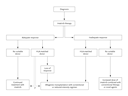
For patients who have an adequate response and an appropriate donor, the question of when to consider transplantation arises. One approach would be to continue imatinib therapy in all such patients except the 10 to 15 percent with a low risk of death from transplantation (i.e., the youngest patients with sibling donors). Transplantation could be considered in the higher-risk patients only when signs of disease progression appeared. However, it remains unclear whether this approach would have an adverse effect on the outcome of transplantation, particularly if transplantation were performed more than 12 months after diagnosis and in many more patients with advanced disease as a result of this approach. Alternatively, attainment of cytogenetic remission with imatinib before transplantation might reduce the risk of leukemic relapse and improve the results of transplantation. Since the rates of response to imatinib are high for all risk groups, it may no longer be possible to use previous prognostic indexes to modulate treatment algorithms. However, the information derived from genomic testing may replace these older methods. In the meantime, while we await the long-term follow-up of patients treated with imatinib, advising patients with newly diagnosed CML who are candidates for transplantation will remain a challenge to physicians.
Source Information
From the Royal Free and University College London Medical School, London.
References
- Chronic Myeloid Leukemia Trialists' Collaborative Group.
Interferon alfa versus chemotherapy for chronic myeloid leukemia: a
meta-analysis of seven randomized trials. J Natl Cancer Inst
1997;89:1616-1620.
[Abstract/Full Text] - Hasford J, Pfirrmann M, Hehlmann R, et al. A new prognostic
score for survival of patients with chronic myeloid leukemia treated with
interferon alfa. J Natl Cancer Inst 1998;90:850-858.
[Abstract/Full Text] - Gratwohl A, Hermans J, Goldman JM, et al. Risk assessment for patients with chronic myeloid leukaemia before allogeneic blood or marrow transplantation. Lancet 1998;352:1087-1092. [ISI][Medline]
- O'Brien SG, Guilhot F, Larson RA, et al. Imatinab compared with
interferon and low-dose cytarabine for newly diagnosed chronic-phase chronic
myeloid leukemia. N Engl J Med 2003;348:994-1004.
[Abstract/Full Text] - Druker BJ, Talpaz M, Resta DJ, et al. Efficacy and safety of a
specific inhibitor of the BCR-ABL tyrosine kinase in chronic myeloid
leukemia. N Engl J Med 2001;344:1031-1037.
[Abstract/Full Text] - Druker BJ, Sawyers CL, Kantarjian H, et al. Activity of a
specific inhibitor of the BCR-ABL tyrosine kinase in the blast crisis of
chronic myeloid leukemia and acute lymphoblastic leukemia with the
Philadelphia chromosome. N Engl J Med 2001;344:1038-1042. [Erratum, N Engl J
Med 2001;345:232.]
[Abstract/Full Text] - Branford S, Walsh S, Rudzki Z, et al. Imatinib produces significantly superior molecular responses compared to interferon plus low dose Ara-C in patients with newly diagnosed chronic myeloid leukaemia in chronic phase. Blood 2002;100:96a-96a. abstract.
- Goldman J. Implications of imatinib mesylate for hematopoietic stem cell transplantation. Semin Hematol 2001;38:Suppl 8:28-34. [ISI][Medline]
- Thiesing JT, Ohno-Jones S, Kolibaba KS, Druker BJ. Efficacy of
STI571, an abl tyrosine kinase inhibitor, in conjunction with other
antileukemic agents against bcr-abl-positive cells. Blood 2000;96:3195-3199.
[Abstract/Full Text] - Tipping AJ, Mahon FX, Zafirides G, Lagarde V, Goldman JM, Melo JV. Drug responses of imatinib mesylate-resistant cells: synergism of imatinib with other chemotherapeutic drugs. Leukemia 2002;16:2349-2357. [ISI][Medline]