NEJM
Perspective
|
Vincent T. DeVita, Jr., M.D.
The greatest derangement of the mind is to believe in something because one wishes it to be so.
� Ren� J. Dubos, 1876
The two articles on Hodgkin's disease in this issue of the Journal � one by Aleman et al. (pages 2396�2406) and one by Diehl et al. (pages 2386�2395) � provide an unusual opportunity to reflect on the evolution of the treatment of Hodgkin's disease and some of the mysterious ways in which competition among specialties affects the design of clinical trials.
In the 1960s, as part of a more global experiment on the curative potential of chemotherapy, investigators at the National Cancer Institute (NCI) set out to test the hypothesis that combination chemotherapy with mechlorethamine, vincristine, procarbazine, and prednisone (MOPP) was capable of curing advanced Hodgkin's disease. By 1970, the answer proved to be yes. Radiotherapy was well established as a treatment for localized disease at the time MOPP chemotherapy was introduced. The availability of a curative treatment for advanced disease raised the issue of its usefulness in earlier stages as well, because in every relevant rodent-tumor model, there has been an inverse relation between the number of cells and curability.
Two other NCI studies of note followed. One randomized trial showed that there was no additional benefit to the use of maintenance treatment in patients who had had a complete remission, confirming that such patients were often cured. Cured patients then and now should not be expected to benefit from any form of additional treatment. And in a subsequent randomized study at the NCI, MOPP was compared with radiotherapy in patients with early Hodgkin's disease to test the inverse rule, and combination chemotherapy proved to be statistically superior to radiotherapy. As the results of all these trials were confirmed, the ground was set for a complete change in the management of Hodgkin's disease.
And, indeed, this happened. The fact that about 60 percent of all patients with Hodgkin's disease present with advanced disease caused a major shift in the jurisdiction of the management of Hodgkin's disease from therapeutic radiology to the emerging specialty of medical oncology, with all the attendant angst. National mortality rates had stabilized after the introduction of linear accelerators in the early 1960s, but in the 15 years that followed the publication of the first results of the MOPP program in 1967, the national mortality rate due to Hodgkin's disease plummeted by more than 70 percent (see Figure).
|
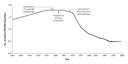
Then a blending process took place. Combination chemotherapy was added to radiotherapy for early-stage disease rather than tested further as a substitute for it. When patients in remission have a relapse, it tends to be in previously involved areas; thus, radiotherapy was added as an adjunct to chemotherapy in patients with advanced disease � again, without adequate testing. In other words, patients received all types of available therapy, and peaceful coexistence was achieved among the specialties. This combined approach has actually become the norm. Only an exceptional clinical trial would investigate the effect of eliminating either approach from the therapeutic equation.
The long-term carcinogenic effect of combining chemotherapy with radiotherapy has turned out to be far too severe, however, to warrant continuing with this approach. Despite confusion in the interpretation of data on this topic, neither approach is very carcinogenic in patients who are treated once and cured. Despite concern about the leukemogenicity of MOPP, for example, the risk of a second cancer among previously untreated patients after MOPP alone or in combination with radiotherapy is less than 3 percent. And doxorubicin, bleomycin, vinblastine, and dacarbazine (ABVD), the more commonly used treatment today, is even less carcinogenic than MOPP when it is used alone. Add radiotherapy to the regimen, and the risk of second cancers increases substantially.
Radiotherapy by itself increases the risk of late second solid tumors in the irradiated field, and the incidence rises steeply when radiotherapy and chemotherapy are combined. That is why the study by Aleman et al., on behalf of the European Organization for Research and Treatment of Cancer Lymphoma Group, is so important. Although there have been ample suggestions in other studies that radiotherapy provides no overall benefit when used as an adjunct to chemotherapy, the study by Aleman et al. offers the most definitive proof that this is so. And the early risk of a second cancer was nearly twice as great in the group that received adjuvant radiotherapy as in the group that received chemotherapy alone.
The article by Diehl et al., on behalf of the German Hodgkin's Lymphoma Study Group, shows that the increased-dose regimen of bleomycin, etoposide, doxorubicin, cyclophosphamide, vincristine, procarbazine, and prednisone (BEACOPP) may represent the first real improvement in 10 years in an approach involving chemotherapy as the initial treatment for patients with advanced disease. The rates of tumor control approached 90 percent, with an acceptable level and incidence of acute toxic effects. This approach proved significantly more effective than did alternating two standard combination-therapy programs. However, approximately 70 percent of patients did receive radiotherapy at previously involved sites, and predictably, the risk of marrow dysplasia and leukemia was substantial and is likely to increase over time. The data of Aleman et al. suggest that their excellent results might be achieved without these late risks if the chemotherapy regimen is used alone.
It has been gratifying to see Hodgkin's disease change from a largely incurable condition to a mostly curable one during my professional lifetime. But despite a very large number of clinical trials, we have taken too long to pose some of the more obvious questions, a number of which surfaced many years ago and which might simplify treatment and reduce the long-term risks � even if it means ultimately excluding one specialty or another from the management of this disease.
Source Information
From the Yale Cancer Center, Yale University School of Medicine and Yale�New Haven Hospital, New Haven, Conn.