NEJM
Editorial
|
Eberhard Ritz, M.D.
Diabetes mellitus causes a dramatic increase in mortality, particularly from cardiovascular causes: the survival rate among persons with either type 1 or type 2 diabetes and no history of coronary heart disease was reported to be as poor as that of survivors of myocardial infarction.1 Although accounting for only approximately 10 percent of all cases of diabetes, type 1 diabetes has been investigated far more completely than other forms. Trials concerning the importance of glycemic control2,3 or the response of nephropathy to intervention with antihypertensive agents4,5 have shown, however, that with certain limitations, the results of interventional studies of type 1 diabetes can be extrapolated to type 2 diabetes.6 This finding is important, because the World Health Organization estimates that by 2010, 200 million people will have diabetes.7 It is certainly no exaggeration to state that from a public health perspective, appropriate management of this threat will be a major challenge to medicine.
According to ancient medical wisdom, an ounce of prevention is worth a pound of cure. With respect to diabetic nephropathy, the most important task is to prevent the renal complications of diabetes through early intervention. Since this task will consume medical resources, early recognition of patients with diabetes who are at high risk for renal and cardiovascular complications is necessary to permit targeted intervention.
In a seminal observation, reported more than 15 years ago, Borch-Johnsen and Kreiner8 noted that proteinuria was a powerful predictor of shortened survival in patients with type 1 diabetes, and this was also subsequently shown to be true in patients with type 2 diabetes.9 These observations indicate that renal involvement is a pivotal development in diabetes, signifying a high risk not only of end-stage renal failure but also, and more important, of vascular complications. Although a nephrocentric view of the medical universe is not uncommon among nephrologists, modesty requires that one admit the possibility that nephropathy is not the cause but an indicator of a more general vascular dysfunction. In this issue of the Journal two articles � one by Nathan et al. from the Diabetes Control and Complications Trial10 and one by Perkins et al.11 � address the issue of the early detection of renal involvement in diabetes, on the one hand, and, on the other, the value of carotid-artery intima�media thickness as a surrogate marker of vascular complications and the relation of this value to glycemic control and albuminuria. These studies provide information that will certainly affect strategies for the early detection of diabetic nephropathy in patients with type 1 diabetes and early intervention. Although the situation is more complex in type 2 diabetes, the results are of interest for this more prevalent type of diabetes as well.
Nathan et al.10 performed a follow-up study of patients in the Diabetes Control and Complications Trial. In the past, the relation between glycemic control and macrovascular complications was not firmly established. Now, Nathan et al. have documented that patients who had initially been assigned to intensified glycemic control, despite having no short-term changes in intima�media thickness, have signs of long-term benefit from good control. This observation proves the wisdom and clairvoyance of Elliot Joslin, who stated decades ago, "With a missionary zeal, one must convert not only the patient's mind and soul, but also his doctor to the realisation that it is worth the effort to control the disease as shown by sugar-free urine, normal blood sugar and cholesterol."12
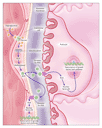
Although the importance of glycemic control can no longer be denied, the data should not be misconstrued to indicate that we simply have to control glycemia and forget about the rest of the vascular risk factors. A recent article in the Journal13 showed that a multifactorial approach attacking not only glycemia but also hyperlipidemia, blood-pressure elevation, and smoking (predictably, not terribly successfully) caused a dramatic reduction in macrovascular end points. The multifactorial genesis of vascular damage was also illustrated indirectly by Nathan et al., who noted that an increase in carotid intima�media thickness was associated with age (which is, unfortunately, not susceptible to intervention) as well as with systolic blood pressure, smoking, the ratio of low-density lipoprotein to high-density lipoprotein, and urinary albumin excretion. What is impressive is that it took three years for the vascular effects to become evident and that, sadly, glycemic control had greatly deteriorated after the study treatment ended. The observation is also mechanistically plausible, since endothelial cells are a known target of glycemia-generated reactive oxygen species,14 generate advanced glycosylation end products, and express the receptor for advanced glycation end products (Figure 1). It is reasonable, but currently unproved, to assume that the same pathogenetic mechanisms occur in glomerular endothelial cells and podocytes as well. However, in our enthusiasm about the importance of rigorous glycemic control, we must not forget the risk of hypoglycemia. Thus, careful, individual evaluation of the risk�benefit ratio remains a sensible approach.
|
The study by Nathan et al.10 also illustrates the relation of microalbuminuria to vascular complications such as intima�media thickening. The validity of microalbuminuria as an index is further addressed by Perkins et al.11 In the past, a large day-to-day variability in urinary albumin excretion was noted. This observation led the American Diabetes Association to recommend that microalbuminuria not be diagnosed unless two of three independent examinations document elevated urinary albumin levels. The study by Perkins et al. adds another twist by showing that the onset of microalbuminuria does not irrevocably seal the fate of the patient: the authors observed regression of albuminuria, defined as a 50 percent reduction in the urinary excretion of albumin between successive two-year periods, in a sizable proportion of patients. This observation should not be misunderstood to indicate that microalbuminuria is an unreliable indicator. Rather, it lends a note of optimism, since it provides indirect, although uncontrolled, evidence that aggressive management does pay dividends: regression was seen in patients who had had microalbuminuria for only a short period (and presumably had only incipient renal damage) and in those with low levels of glycosylated hemoglobin, systolic blood pressure, and cholesterol or triglycerides.
Of course, the study was not designed to show whether regression of microalbuminuria ultimately translates into a decreased frequency of the hard end points of progression to end-stage renal disease. Indeed, such a study would be very difficult to perform. Nevertheless, it provided welcome documentation that a widely accepted surrogate marker for the progression of renal disease can be favorably influenced. This point is the more important because Adler et al.15 showed that the glomerular expression of genes involved in the genesis of diabetic glomerulosclerosis is increased in patients with type 1 diabetes with microalbuminuria, indicating that microalbuminuria is not merely a predictor of diabetic nephropathy but also constitutes evidence of the presence of diabetic renal damage.
In the absence of histologic documentation, it is impossible to be certain that decreased albumin excretion indicates the recovery of glomerular integrity, as Perkins et al. speculate, but this possibility is definitely not excluded, given the evidence that delayed improvement of diabetic glomerulosclerosis occurs after isolated pancreas transplantation.16 One aspect of the study by Perkins et al. should be emphasized: the chance of regression was greater with microalbuminuria of short duration than with long-standing microalbuminuria. It stands to reason that these landmark studies will heighten physicians' awareness of the importance of screening for microalbuminuria to permit aggressive early intervention, particularly intervention that leads to tight glycemic control.
Source Information
From the University of Heidelberg, Heidelberg, Germany.
References
- Haffner SM, Lehto S, R�nnemaa T, Py�r�l� K, Laakso M.
Mortality from coronary heart disease in subjects with type 2 diabetes and
in nondiabetic subjects with and without prior myocardial infarction. N Engl
J Med 1998;339:229-234.
[Abstract/Full Text] - The Diabetes Control and Complications Trial Research Group. The
effect of intensive treatment of diabetes on the development and progression
of long-term complications in insulin-dependent diabetes mellitus. N Engl J
Med 1993;329:977-986.
[Abstract/Full Text] - UK Prospective Diabetes Study (UKPDS) Group. Intensive blood-glucose control with sulphonylureas or insulin compared with conventional treatment and risk of complications in patients with type 2 diabetes (UKPDS 33). Lancet 1998;352:837-853. [Erratum, Lancet 1999;354:602.] [CrossRef][ISI][Medline]
- Lewis EJ, Hunsicker LG, Clarke WR, et al. Renoprotective effect
of the angiotensin-receptor antagonist irbesartan in patients with
nephropathy due to type 2 diabetes. N Engl J Med 2001;345:851-860.
[Abstract/Full Text] - Lewis EJ, Hunsicker LG, Bain RP, Rohde RD. The effect of
angiotensin-converting-enzyme inhibition on diabetic nephropathy. N Engl J
Med 1993;329:1456-1462. [Erratum, N Engl J Med 1993;330:152.]
[Abstract/Full Text] - Wolf G, Ritz E. Diabetic nephropathy in type 2 diabetes
prevention and patient management. J Am Soc Nephrol 2003;14:1396-1405.
[Full Text] - Zimmet P, Alberti KG, Shaw J. Global and societal implications of the diabetes epidemic. Nature 2001;414:782-787. [CrossRef][ISI][Medline]
- Borch-Johnsen K, Kreiner S. Proteinuria: value as predictor of cardiovascular mortality in insulin dependent diabetes mellitus. Br Med J (Clin Res Ed) 1987;294:1651-1654. [ISI][Medline]
- Adler AI, Stevens RJ, Manley SE, et al. Development and progression of nephropathy in type 2 diabetes: The United Kingdom Prospective Diabetes Study (UKPDS 64). Kidney Int 2003;63:225-232. [CrossRef][ISI][Medline]
- The Diabetes Control and Complications Trial/Epidemiology of
Diabetes Interventions and Complications Research Group. Intensive diabetes
therapy and carotid intima-media thickness in type 1 diabetes mellitus. N
Engl J Med 2003;348:2294-2303.
[Abstract/Full Text] - Perkins BA, Ficociello LH, Silva KH, Finkelstein DM, Warram JH,
Krolewski AS. Regression of microalbuminuria in type 1 diabetes. N Engl J
Med 2003;348:2285-2293.
[Abstract/Full Text] - Joslin EP. The treatment of diabetes mellitus. 10th ed. Philadelphia: Lea & Febiger, 1959.
- Gaede P, Vedel P, Larsen N, Jensen GVH, Parving H-H, Pedersen
O. Multifactorial intervention and cardiovascular disease in patients with
type 2 diabetes. N Engl J Med 2003;348:383-393.
[Abstract/Full Text] - Brownlee M. Biochemistry and molecular cell biology of diabetic complications. Nature 2001;414:813-820. [CrossRef][ISI][Medline]
- Adler SG, Kang SW, Feld S, et al. Glomerular mRNAs in human type 1 diabetes: biochemical evidence for microalbuminuria as a manifestation of diabetic nephropathy. Kidney Int 2001;60:2330-2336. [Erratum, Kidney Int 2002;61:1197.] [CrossRef][ISI][Medline]
- Fioretto P, Steffes MW, Sutherland DER, Goetz FC, Mauer M.
Reversal of lesions of diabetic nephropathy after pancreas transplantation.
N Engl J Med 1998;339:69-75.
[Abstract/Full Text]