NEJM
Perspective
|
Robin K. Avery, M.D.
Vasculopathy of cardiac allografts is a major therapeutic challenge, occurring in 50 percent or more of heart-transplant recipients in the first several years after surgery. Improving survival for these patients will require the use of new strategies to prevent this relentlessly progressive complication. Allograft vasculopathy involves diffuse narrowing and occlusion of the coronary arteries, rather than the more focal lesions of conventional atherosclerosis (see Figure).1 The addition of intravascular ultrasonography to standard coronary angiography increases the sensitivity of the procedure for diagnosis and provides a concentric view of the vessel under study.
|
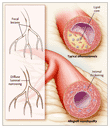
Events during the first year after transplantation appear to be important in the pathogenesis of vasculopathy of the allograft.1 Immunologic events involving alloreactive T cells and the humoral immune system, as well as nonimmunologic factors, including an older donor age, injury due to ischemia and reperfusion, hyperlipidemia, and infections, appear to play a part in this complex process, in which initial endothelial injury is followed by intimal hyperplasia and the proliferation of vascular smooth-muscle cells. In studies in animals and humans, investigators have found multiple mediators and cytokines to be up-regulated in hearts that show signs of allograft vasculopathy. Some of these reflect ongoing immune activation; others are markers of endothelial activation and impairment of antithrombotic mechanisms. A growing body of literature supports the idea that viral infections, particularly cytomegalovirus infections, may also contribute to allograft vasculopathy.
Therapy for allograft vasculopathy has been disappointing. Statin lipid-lowering agents and calcium-channel blockers have some protective effect, but they do not eliminate the problem. Moreover, the diffuse obliterative process involving distal vessels is often not amenable to revascularization.
Cellular proliferation appears to be central to the pathogenesis of allograft vasculopathy, leading researchers to ask whether inhibitors of such proliferation might be protective. Sirolimus and everolimus are members of a new class of macrocyclic immunosuppressive agents with unique antiproliferative activity. In studies in animals, sirolimus has been shown to reduce the incidence of allograft vasculopathy, and in a recent, randomized study of 46 patients by Mancini et al., sirolimus appeared to slow the progression of established cardiac-allograft vasculopathy.2
In this issue of the Journal (pages 847�858), Eisen et al. present the results of a large, multicenter, randomized trial comparing everolimus (at two doses, 1.5 mg per day and 3.0 mg per day) and azathioprine, each in combination with prednisone and cyclosporine, for the prevention of vasculopathy after heart transplantation. Statin lipid-lowering agents were administered to all patients. Intravascular ultrasonography was performed at base line (within the first 6 weeks after transplantation) and at 12 months.
In the groups receiving everolimus, significantly fewer patients reached the composite primary end point of death, graft loss or retransplantation, loss to follow-up, rejection of grade 3A or higher, or rejection involving hemodynamic compromise. Rates of graft loss and death did not differ significantly among the study groups, but the group receiving azathioprine had a higher incidence of rejection of at least grade 3A than did the everolimus groups. The results of intravascular ultrasonography showed that the change in intimal variables, including the increase in the maximal intimal thickness, was significantly smaller in both everolimus groups. The incidence of vasculopathy was lower in the everolimus groups, particularly the higher-dose group.
This study is important for several reasons. First, it is unique among large randomized studies in showing the effect of a particular immunosuppressive regimen on the development of allograft vasculopathy. If these differences persist in subsequent years, this effect of everolimus could translate into a substantial long-term benefit for patients who received the drug.
Second, the differential incidence of infections is of interest. With approximately 75 percent of patients receiving prophylaxis against cytomegalovirus infection, the incidence of cytomegalovirus disease was considerably lower in the everolimus groups (7.7 percent in the group that received 1.5 mg and 7.6 percent in the group that received 3.0 mg, as compared with 21.5 percent in the azathioprine group). It is tempting to speculate that this difference contributed to the lower incidence of allograft vasculopathy in the groups given everolimus, but a causal effect is not yet clear. Since preemptive monitoring for cytomegalovirus viremia was optional, this study cannot be used to evaluate the incidence of asymptomatic viremia; it has been suggested that protracted low-level viremia may have an effect on the development of vasculopathy. Nonetheless, in follow-up analyses of the current study group, it will be interesting to see whether there is a higher incidence of allograft vasculopathy among patients who had cytomegalovirus disease, as well as whether there is a reduced incidence of post-transplantation lymphoproliferative disease in the everolimus groups.
Several other effects of everolimus in this study are of potential concern to clinicians. The high discontinuation rate, especially in the group receiving 3.0 mg of everolimus (nearly 40 percent), is noteworthy. Thrombocytopenia and elevated lipid levels (despite the administration of statins) were more frequently seen in the everolimus groups. The clinical significance of these findings over time is not yet known. The greater increase in the levels of serum creatinine in the everolimus groups led to a reduction in the target cyclosporine trough levels specified in the protocol � an effect that is being addressed in an amendment to the ongoing study. The higher rate of bacterial infection in the group assigned to 3.0 mg of everolimus is a potential issue. Although sirolimus has been linked to wound infections and delayed healing in some studies, the difference in this study was not attributable to wound infections.
In summary, this is an exciting study that suggests that the choice of an initial immunosuppressive regimen may influence the prognosis with regard to allograft vasculopathy after heart transplantation. The effects of a regimen that contained everolimus in this study included a decrease in the number of severe episodes of acute rejection, a reduction in indicators of the development of allograft vasculopathy 12 months after transplantation, and a reduced incidence of cytomegalovirus disease. Whether these early findings will translate into increased longevity and decreased graft loss in future years will be important to confirm.
Source Information
From the Department of Infectious Disease and Transplant Center, Cleveland Clinic Foundation, Cleveland.
References
- Kirklin JK, Young JB, McGiffin DC, Benza RL, Tallaj J. Cardiac allograft vasculopathy (chronic rejection). In: Kirklin JK, Young JB, McGiffin DC, eds. Heart transplantation. New York: Churchill Livingstone, 2002:615-65.
- Mancini D, Pinney S, Burkhoff D, et al. Use of rapamycin slows
progression of cardiac transplantation vasculopathy. Circulation
2003;108:48-53.
[Abstract/Full Text]