NEJM
Editorial
|
Mary M. Lee, M.D.
In a 1953 editorial entitled "The Need for an Inhibitor of Gonadotropin," Lawson Wilkins noted that a "method of suppressing the secretion of pituitary gonadotropins . . . might lead to the prevention or control of sexual precocity."1 Almost 30 years later, Crowley and colleagues reported successful suppression of early puberty in a two-year-old girl with the use of a long-acting analogue of a luteinizing hormone�releasing hormone (LHRH) agonist.2 In the intervening years, the nature of the hypothalamic�pituitary�gonadal axis was elucidated, LHRH was isolated, and maturational changes in the reproductive axis were characterized (Figure 1).
|
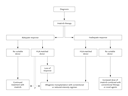
Before puberty, the LHRH neurons are under tonic neural inhibition, and the hypothalamic�pituitary�gonadal axis is relatively quiescent, with barely discernible pulses of follicle-stimulating hormone and luteinizing hormone. An initial nocturnal rise in the amplitude and frequency of luteinizing hormone pulses heralds the onset of puberty. As puberty progresses, gonadotropin pulses increase in amplitude, stimulating the production of sex steroids.
Recognition of these physiologic changes in the pattern of follicle-stimulating hormone and luteinizing hormone release during pubertal maturation led to studies demonstrating that pulsatile secretion of LHRH is essential to sustain gonadotropin secretion.3 Conversely, a continuous exogenous infusion of LHRH suppresses gonadotropin secretion by desensitizing the pituitary gonadotrophs (Figure 1). 3 These observations stimulated the design of long-acting synthetic analogues of LHRH for use in manipulating the reproductive axis. Administration of a long-acting LHRH agonist in children with gonadotropin-dependent precocious puberty reverses the pubertal luteinizing hormone and follicle-stimulating hormone pattern, reducing the secretion of sex steroids and retarding pubertal progression.2 As a result, linear growth and epiphyseal maturation are reduced to prepubertal rates, and actual adult height is greater than that predicted before treatment.
The potential to enhance linear growth by delaying epiphyseal closure, thereby prolonging the period of prepubertal growth, provided the rationale for testing whether LHRH-agonist therapy could augment height in short adolescents with normal pubertal development. In this issue of the Journal, Yanovski and his coworkers report the efficacy of treatment with an LHRH agonist in adolescents with a normal onset of puberty and short stature.4 The mean adult height in the LHRH-agonist group was 7 cm greater than that in the placebo group and was 4.2 cm greater than the adult height predicted before treatment (a gain of 0.6 in the standard-deviation score), although it was still 0.8 SD below the midparental height. Previous studies have shown that pubertal suppression results in a limited improvement in the predicted adult height in short children with normally timed puberty.5,6 Yanovski and coworkers extended the intervention to 4 years (mean duration, 3.5 years), which resulted in a moderate gain attained in height.4 However, the gain was not achieved without cost. Vertebral bone mineral density in the LHRH-agonist group was 1.6 SD below the population mean and was significantly lower than that in the placebo group (0.3 SD below the population mean) at the completion of therapy. Moreover, 82 percent of the subjects with idiopathic short stature who were treated with the LHRH agonist had a bone mineral density that was more than 1 SD below the population mean. The reduction in bone mineral density was not an unexpected finding, given the effects of sex steroids on bone mineral accretion and the report of sustained osteopenia in men with a history of delayed puberty.7 Eighteen subjects treated with an LHRH agonist and followed for a mean of 2.7 years after they had achieved adult height � a period of active bone mineral accretion � had no appreciable increase in the standard-deviation score for bone mineral density as compared with 12 subjects who received placebo.4 The reduced bone mineral density in the LHRH-agonist group and its failure to improve after the completion of linear growth are worrisome and, as the authors note, are cause for concern about the long-term risk of fracture with this regimen.
What other detrimental effects might be anticipated with this therapy? Will suppression of the normal hypothalamic�pituitary�gonadal axis for four years compromise full recovery of the axis, affecting future reproductive functioning? One study showed that five years after the discontinuation of LHRH-agonist therapy for precocious puberty, the mean ovarian volume remained increased and subtle differences in the luteinizing hormone response to gonadotropin-releasing hormone persisted.8 The importance of these abnormalities and whether they will resolve with longer follow-up are unclear. The elevated body-mass index observed in girls treated with an LHRH agonist is probably associated with precocious puberty itself rather than with the treatment.9 A decline in cognitive function was found in men treated with an LHRH agonist for prostate cancer,10 renewing concern about the potential risks of emotional lability, depression, and neurocognitive dysfunction associated with LHRH-agonist therapy in women.
In addition to these clinical issues, a risk�benefit analysis must take into account psychosocial factors, which are less easily quantifiable. What are the consequences of inducing pubertal arrest in healthy young adolescents (i.e., perturbing normal physiology) in order to increase stature? What are the effects of prolonged pharmacologic intervention on the perception of self in an otherwise healthy adolescent? The moderate gain in height after four years of LHRH-agonist therapy in the study by Yanovski et al. and the variability in the treatment response suggest that for many adolescents, this treatment is unlikely to result in a substantial gain in adult height. Do families have realistic expectations of this intervention? Will treatment failure exacerbate psychosocial problems? Yanovski et al. state, "Adolescents who thought that the study medication was ineffective or who found an interruption of normal puberty unacceptable were not encouraged to continue treatment."4 Although it is unclear which subjects discontinued treatment for these reasons, the high dropout rates in both the placebo group and the treatment group suggest dissatisfaction with the intervention and the perceived outcome.
Parallels can be drawn between the use of an LHRH agonist in pubertal adolescents with short stature and the administration of growth hormone in normal short children. Both treatments are expensive and require parenteral administration to augment height in otherwise healthy children at the low end of the bell-shaped curve for stature. As with several subjects in the study by Yanovski et al., growth hormone and LHRH agonists are sometimes used in combination to augment height.4 Is intervention justified by the argument that short stature represents a continuum of dysfunction in growth hormone secretion or action? Proponents of pharmacologic treatment for idiopathic or genetic short stature have argued that short stature is associated with substantial psychosocial morbidity. In two studies, however, short children in the community (those with a height below the 3rd percentile) and children referred to a pediatric endocrine clinic for short stature (a height below the 5th percentile) did not have any serious psychosocial problems related to stature.11,12 Moreover, the psychological findings in a group of normal short children at base line and after five years of growth hormone treatment were similar to the findings in untreated short children and those of average height.13 The treated group had improvement in height without any discernible differences in psychosocial factors, including self-esteem, academic performance, and behavior, calling into question the psychosocial rationale for providing treatment to augment height. Aside from considerations of efficacy and safety, the ethical and economic ramifications of this approach have been debated at length.14,15 The estimated annual cost of growth hormone treatment for a child with a weight of 30 kg is approximately $15,000 to $30,000, and the cost of LHRH-agonist therapy is $10,000 to $15,000. The routine use of either agent or both to treat short stature would therefore entail an enormous expense that would strain resources and affect the allocation of health care dollars.
Children whose height is below the 3rd percentile, those with stature that is not commensurate with their genetic potential, and those with a growth rate that is below the 25th percentile should be evaluated by a pediatric endocrinologist in order to rule out treatable causes of short stature � not only growth hormone deficiency but also endocrine-related conditions such as hypothyroidism, hypercortisolism, skeletal dysplasias, and syndromes associated with poor growth. Many nonendocrine conditions can also be manifested as short stature, including celiac disease, cystic fibrosis, psychosocial deprivation, and occult renal disease. If idiopathic short stature is severe enough to be physically debilitating, affecting daily life, pharmacologic intervention might be considered. The findings by Yanovski and coworkers call for caution in the routine use of an LHRH agonist to enhance height, beyond the ethical, societal, and economic considerations. To the balance sheet, one must add the variable efficacy of LHRH-agonist therapy, the negative sequelae of decreased bone mineral density, and the psychosocial consequences of prolonged parenteral therapy and pubertal arrest in an otherwise healthy adolescent.
Source Information
From Duke University Medical Center, Durham, N.C.
References
- Wilkins L. The need for an inhibitor of gonadotropin. J Clin Endocrinol Metab 1953;13:739-741. [ISI]
- Crowley WF Jr, Comite F, Vale W, Rivier J, Loriaux DL, Cutler GB Jr. Therapeutic use of pituitary desensitization with a long-acting LHRH agonist: a potential new treatment for idiopathic precocious puberty. J Clin Endocrinol Metab 1981;52:370-372. [Abstract]
- Belchetz PE, Plant TM, Nakai Y, Keogh EJ, Knobil E. Hypophysial responses to continuous and intermittent delivery of hypothalamic gonadotropin-releasing hormone. Science 1978;202:631-633. [ISI][Medline]
- Yanovski JA, Rose SR, Municchi G, et al. Treatment with a
luteinizing hormone-releasing hormone agonist in adolescents with short
stature. N Engl J Med 2003;348:908-917.
[Abstract/Full Text] - Carel JC, Hay F, Coutant R, Rodrigue D, Chaussain JL. Gonadotropin-releasing hormone agonist treatment of girls with constitutional short stature and normal pubertal development. J Clin Endocrinol Metab 1996;81:3318-3322. [Abstract]
- Lindner D, Job JC, Chaussain JL. Failure to improve height prediction in short-stature pubertal adolescents by inhibiting puberty with luteinizing hormone-releasing hormone analogue. Eur J Pediatr 1993;152:393-396. [ISI][Medline]
- Finkelstein JS, Klibanski A, Neer RM. A longitudinal evaluation of bone mineral density in adult men with histories of delayed puberty. J Clin Endocrinol Metab 1996;81:1152-1155. [Abstract]
- Feuillan PP, Jones JV, Barnes K, Oerter-Klein K, Cutler GB Jr.
Reproductive axis after discontinuation of gonadotropin-releasing hormone
analog treatment of girls with precocious puberty: long term follow-up
comparing girls with hypothalamic hamartoma to those with idiopathic
precocious puberty. J Clin Endocrinol Metab 1999;84:44-49.
[Abstract/Full Text] - Palmert MR, Mansfield MJ, Crowley WF Jr, Crigler JF Jr, Crawford
JD, Boepple PA. Is obesity an outcome of gonadotropin-releasing hormone
agonist administration? Analysis of growth and body composition in 110
patients with central precocious puberty. J Clin Endocrinol Metab
1999;84:4480-4488.
[Abstract/Full Text] - Green HJ, Pakenham KI, Headley BC, et al. Altered cognitive function in men treated for prostate cancer with luteinizing hormone-releasing hormone analogues and cyproterone acetate: a randomized controlled trial. BJU Int 2002;90:427-432. [ISI][Medline]
- Sandberg DE, Brook AE, Campos SP. Short stature: a psychosocial burden requiring growth hormone therapy? Pediatrics 1994;94:832-840. [Abstract]
- Downie AB, Mulligan J, Stratford RJ, Betts PR, Voss LD. Are
short normal children at a disadvantage? The Wessex growth study. BMJ
1997;314:97-100.
[Abstract/Full Text] - Downie AB, Mulligan J, McCaughey ES, Stratford RJ, Betts PR, Voss LD. Psychological response to growth hormone treatment in short normal children. Arch Dis Child 1996;75:32-35. [Abstract]
- Allen DB, Brook CG, Bridges NA, Hindmarsh PC, Guyda HJ, Frazier D. Therapeutic controversies: growth hormone (GH) treatment of non-GH deficient subjects. J Clin Endocrinol Metab 1994;79:1239-1248. [ISI][Medline]
- Lantos J, Siegler M, Cuttler L. Ethical issues in growth hormone therapy. JAMA 1989;261:1020-1024. [ISI][Medline]