NEJM
Perspective
|
Anthony E. Lang, M.D.
One of the true miracles of modern medicine was the introduction of levodopa, the precursor of dopamine, for the treatment of Parkinson's disease. However, even in the early trials of levodopa, unexpected complications were observed. These included choreoathetotic movements (dyskinesias) and fluctuations from a state of mobility (the "on" period), often accompanied by dyskinesias, to a state of severe parkinsonism ("off" period), sometimes many times a day. These complications become increasingly common and disabling with longer durations of the disease and of exposure to levodopa.
In 1995, researchers from Grenoble, France, first reported that this "levodopa syndrome" responded to high-frequency, deep-brain stimulation targeting the subthalamic nucleus.1 Since then, numerous other groups have replicated the findings, but follow-up has been relatively short (typically less than one year), and no data have been provided on the effect of this treatment on the natural history of the disease.
In this issue of the Journal (pages 1925�1934), Krack et al. report on their prospective study of stimulation of the subthalamic nucleus in 49 patients with Parkinson's disease who were followed for five years. They noted marked amelioration of the classic levodopa-responsive motor features during the off periods in patients who had motor fluctuations repeatedly in the waking state. Painful off-period dystonia also improved. These benefits were largely maintained during the follow-up period, with no evidence of tolerance to the stimulation. Furthermore, levodopa-induced dyskinesias improved considerably and were often eliminated, at least in part because the doses of dopaminergic drugs were greatly reduced.
Not all symptoms improved, however. When patients were on medication, their symptoms were generally unaffected by stimulation. A crucial observation was that stimulation-resistant motor disability, including postural instability, freezing of gait, speech deficits, and akinesia gradually developed in many patients; progressive dementia developed in a few cases. These features are characteristic of patients with Parkinson's disease who are treated for long periods with levodopa. Finally, psychiatric disorders, including hypomania, apathy, and depression, developed in several patients.
Parkinson's disease is characterized by an increase in the inhibitory outflow from the globus pallidus internus and the pars reticulata of the substantia nigra, which in turn reduces the activation of motor cortexes by the motor thalamic relay nuclei. A major contributor to this pathologic output from the basal ganglia is an overactive subthalamic nucleus (see Figure).2
|
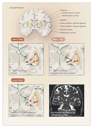
Procedures involving the creation of lesions in the subthalamic nucleus, when performed in a primate model of Parkinson's disease, profoundly improve parkinsonism in these animals. However, surgeons have been reluctant to target the subthalamic nucleus in humans because vascular and surgical accidents in this region often result in hemiballism (violent and disabling dyskinesia) on the opposite side of the body. After observing that high-frequency stimulation of the thalamus mimicked the antitremor effects of a thalamic lesion (thalamotomy), the researchers from Grenoble pioneered the use of deep-brain stimulation in the once "untouchable" subthalamic nucleus in hopes of improving some of the more disabling features of Parkinson's disease.
Although its mechanisms of action remain uncertain, stimulation of the subthalamic nucleus is clearly a major advance in the treatment of Parkinson's disease. However, its efficacy is no greater than that of the traditional gold standard, levodopa. The unique contribution of stimulation therapy is the marked and sustained effect it has on the disabling motor complications that are associated with levodopa therapy.
At the same time, stimulation of the subthalamic nucleus carries risks. It involves an invasive surgical procedure and requires considerable expertise on the part of the surgical and medical teams. Krack and colleagues are a highly experienced group of investigators. They studied relatively young patients (mean age, 55 years) who were preselected on the basis of a persistent good response to levodopa and an absence of dementia or an ongoing psychiatric illness. (Despite the careful screening, one patient committed suicide.)
Stimulation of the subthalamic nucleus should not be used to prevent the development of motor complications or to avoid the use of levodopa or equivalent drugs. Many patients obtain a prolonged and relatively uncomplicated benefit from medication, and the risk of surgical mishaps is unacceptably high in untreated or highly functional patients. However, stimulation therapy should be considered for relatively young patients, before the development of a major disability that threatens their employment and their roles in their family and in society.
Many elderly patients will not be good candidates for stimulation of the subthalamic nucleus. Postural instability, freezing and falls, dysarthria, dysphagia, and cognitive dysfunction are common among elderly patients and appear to progress despite treatment with stimulation. Indeed, the resistance of many features of Parkinson's disease to both levodopa and stimulation therapy serves as an important reminder of the need for more research that will focus on the pathogenesis of this progressive, multiple-system neurodegeneration3 rather than deal exclusively with the consequences of nigrostriatal dopamine deficiency.
Dr. Lang reports that Medtronic has provided an unrestricted
educational grant to the University of Toronto, where he serves as
director of the Movement Disorders Unit.
Source Information
From the University of Toronto, Toronto.
References
- Limousin P, Pollak P, Benazzouz A, et al. Effect on parkinsonian signs and symptoms of bilateral subthalamic nucleus stimulation. Lancet 1995;345:91-95. [ISI][Medline]
- Lang AE, Lozano AM. Parkinson's disease. N Engl J Med
1998;339:1130-1143.
[Full Text] - Braak H, Del Tredici K, Rub U, de Vos RA, Jansen Steur EN, Braak E. Staging of brain pathology related to sporadic Parkinson's disease. Neurobiol Aging 2003;24:197-211. [CrossRef][ISI][Medline]